
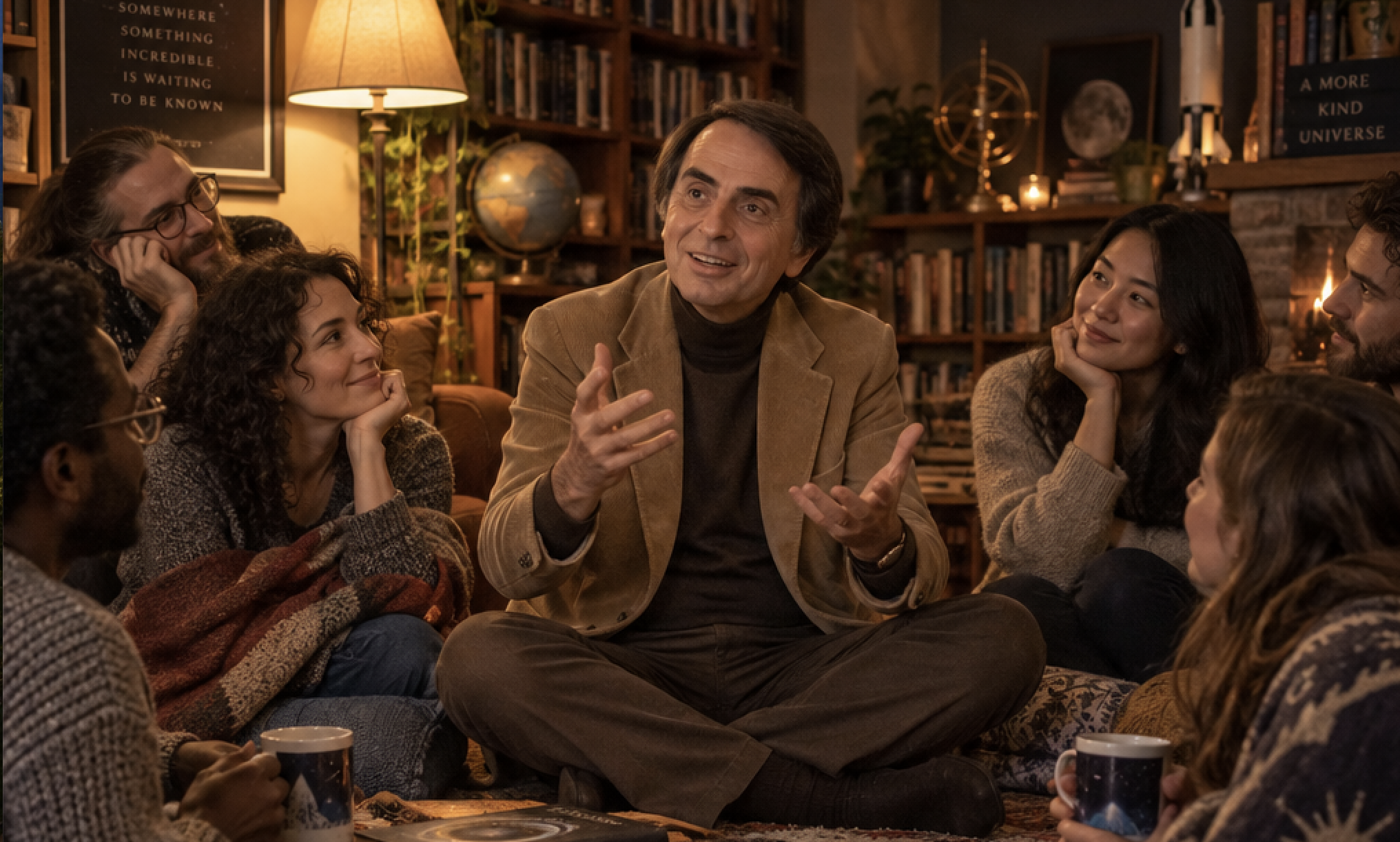
Carl Sagan said that “Creationism is not science—it’s mysticism; it’s religion. I would have no problem with teaching creationism in mythology courses, in courses on social trends, even in courses on religion. But not courses in science, because it is not science.” In fact, evolutionism is a philosophical declaration of faith rather than a testable scientific conclusion, since it cannot be empirically verified. The first line in Sagan’s book Cosmos is, “Nature is all there is or ever will be.” This is not a conclusion to the rigorous study and observation of empirical data. John Robbins nicely sums up the religious nature of Sagan’s governing presupposition.
The statement is not argued; no evidence is presented for our consideration; no hint is given that this statement is open to revision of even the mildest sort. The Sagan has spoken; so let it be written; so let it be done. This tone of dogmatic finality appears in all his books, and while it contradicts what he has to say about science, it is fundamental to his duties as a high priest of science.
Something from nothing, abiogenesis, is a fairy tale. See David Stone’s Darwinian Fairytales: Selfish Genes, Errors of Heredity, and Other Fables of Evolution. Ray Comfort has described something-from-nothing origins as “A Fairy Tale for Grownups.” Robbins again:
Had Dr. Carl Sagan been born in any other century, he would have been known as a teller of stories, a spinner of yarns, a maker of myths. Some of his listeners would have been skeptical; most would have hung on his every word, believing them all to be true, just as they do today. He is a talented storyteller.
The late apologist Ron Carlson summed up the fairy tale analogy well: “In grammar school they taught me that a frog turning into a prince was a fairy tale. In the university they taught me that a frog turning into a prince was a fact!” It’s even more ridiculous than that. At least evolutionists begin with a frog! They need that first spark of life from which to spin their fairy tale.
The Darwinian evolution fairy tale goes something like this: Once upon a time, nothing existed. No creatures from which humans could evolve. No matter or energy. No mind or morals. No information to program the magically appearing lifeform. What we had to begin with was nothing and nobody. Somehow, a miracle occurred when nothing plus nothing produced something! Evolutionists can’t explain this incredible miracle, but it had to happen. They tell us they don’t believe in miracles. They accept this origin story as a fact because of the alternative. Believe anything, no matter how unscientific and irrational, to keep God out of the picture. Instead of following an ethic that states we should love our neighbors, who’s to say it’s evolutionarily wrong to eat our neighbors? That’s how we got here, that and rape!
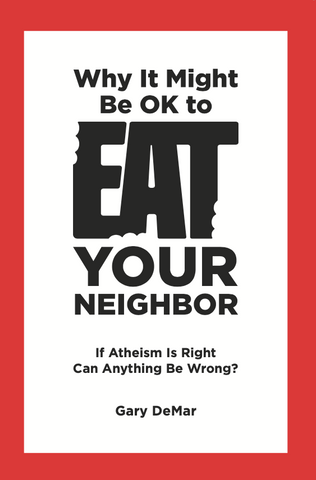
Why It Might Be OK to Eat Your Neighbor
Love your neighbor, or Eat your neighbor? No matter how atheists try, they can’t account for moral standards that must be obeyed when there is no accounting for good or evil. The most damning assessment of a matter-only cosmos devoid of a Creator is that we got to this place in our evolutionary history by acts of violence whereby the strong conquered the weak with no one to support or condemn them.
Buy NowOne of Richard Dawkins’ books is titled The Magic of Reality. An apt description of what people like Sagan assert without evidence or observation. Dawkins describes us as “robot-vehicles blindly programmed to preserve the selfish molecules known as genes.” Wait a minute! What do we know about robots? They are designed and programmed. Who designed and programmed the designers and programmers, and who designed and programmed them? The lesser can’t produce the greater. Non-life cannot give rise to life.
A biotic soup did not evolve into what we see around us today. Sagan, Dawkins, and an entire group of evolution scientists have never been able to create life as we know it from scratch. “While researchers have successfully engineered synthetic genomes and constructed synthetic cells that mimic biological functions, these efforts involve modifying existing living cells or assembling pre-existing biological components rather than generating life from non-living matter.”
And what is the endpoint of this fairy-tale religion? Dawkins tells us: “In the universe of blind physical forces and genetic replication, some people are going to get hurt, and other people are going to get lucky; and you won’t find any rhyme or reason to it, nor any justice. The universe we observe has precisely the properties we should expect if, at the bottom, there is no design, no purpose, no evil and no good. Nothing but blind pitiless indifference. DNA neither knows nor cares. DNA just is, and we dance to its music” (River Out of Eden).
Couple the above comments from Dawkins with the following from Sagan and consider the implications for
In The Dragons of Eden, subtitled Speculations on the Evolution of Human Intelligence, he writes (7): “My fundamental premise about the brain is that its workings—what we sometimes call ‘mind’—are a consequence of its anatomy and physiology, and nothing more. ‘Mind’ may be a consequence of the action of the components of the brain severally or collectively…. We are, to a remarkable degree, the results of the interactions of an extremely complex array of molecules…. Because there is not a shred of evidence to support [sic] it, I will not in these pages entertain any hypotheses on what used to be called the mind-body dualism, the idea that inhabiting the matter of the body is something made of quite different stuff, called mind.”
“The brain is that its workings—what we sometimes call ‘mind’—are a consequence of its anatomy and physiology, and nothing more.” Consider the moral consequences: “My brain made me do it! It’s all part of the evolutionary process. As the eminent evolutionist Richard Dawkins states, “DNA neither knows nor cares. DNA just is, and we dance to its music.’”
Please tell us, without borrowing moral capital from theists, why it would be morally wrong to eat our neighbors instead of loving them?